
Indian economy about to take-off


Prime Minister Narendra Modi, who recently completed one year in office, has, in an exclusive interview with Smita Prakash, editor, ANI, said the opposition alleging that his government is a "suit boot ki sarkar" is definitely better and more acceptable than being labelled a "suitcase" (ki sarkar), and satirically added, that after ruling for sixty years, the Congress has suddenly remembered the poor.

The actual expenditure will only be marginally higher and hence, the multiplier effect will be muted.

Here's the full text of President Ram Nath Kovind's customary address to the joining sitting of Parliament on the first day of the budget session.

Panagariya has advocated a more liberalised spending, arguing that greater capital expenditure could relax some of the infrastructure bottlenecks facing the country.
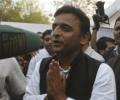
Uttar Pradesh Chief Minister Akhilesh Yadav may not have been able to fix the responsibility for the Samajwadi Party's dismal performance at the recently concluded Lok Sabha elections.

About one-third of the world's poor live in India but there are countries where 88 per cent of population is extremely poor.

Progress on several parameters creates a tipping point situation.
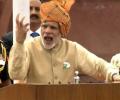
As Prime Minister Narendra Modi is set to deliver his third Independence Day speech on August 15, he is inviting ideas from citizens on issues he should speak on

The public-private partnership model is a compulsion, says the minister.

Budget in the medium term aims to kick-start the investment cycle.

Finance Minister Nirmala Sitharaman on Monday presented the Budget for 2021-22 in the Lok Sabha that is expected to provide relief to the pandemic-hit common man as well as focus more on driving economic recovery through higher spending on healthcare, infrastructure and defence amid rising tensions with neighbours, As India emerges from the COVID-19 crisis, the ninth Budget under the Modi government, including an interim one, is widely expected to focus on boosting spending on job creation and rural development, generous allocations for development schemes, putting more money in the hands of the average taxpayer and easing rules to attract foreign investments.

Finance Minister Arun Jaitley on Monday presented the Union Budget for 2016-17.

The industry's reactions to the Budget have been mixed.
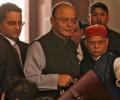
Jaitley said a 10 per cent tax long on capital gains exceeding Rs 1 lakh made from the sale of shares has been introduced but those made till Janaury 31 would be grandfathered. A 10 per cent tax on distributed income by equity oriented mutual funds has also been proposed in the budget.

'There will always be hiccups given that the Namami Gange programme is spread over different sectors and involves several agencies.'

Once these banks start showing losses, they will not be able to pay dividends to the government nor pay taxes, which will further aggravate the situation for the government as its return on investment as an investor would be very negligible for the next few years, says M V Subramanian.

Against a turbulent and uncertain background, Budget 2017-18 hewed a steady, forward-looking course, says Shankar Acharya, former chief economic adviser to the government.
'Success will require political skill, not just economic expertise'

'The corporate sector says by 2022 they will create 300 million jobs.' 'In the last 70 years we didn't do it, how will we do it in 5 years?' 'Only agriculture can bail out the economy. Unfortunately, it is not being looked into.'

Tax incentives to have cascading effect on the capital goods industry.

Economy to grow by 7.2-7.5 per cent in second half of current fiscal, says FM.

This Budget signals a shift from a hand-out to a hand-up economy.

Instead of a consumption stimulus the government must address the NPA issue with a war footing and invest in infrastructure, affordable housing and exports, says Sanjeev Nayyar.
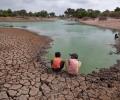
Renewable energy is mistakenly restricted to electricity.

'That is not a democratic ideal obviously, but it is a practical reality.' 'It is a consistent feature of politicians in Pakistan that their rhetoric on the army softens the closer they get to the seat of power.'
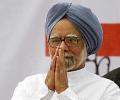
The most immediate cause of worry is the recent volatility in foreign exchange markets, Prime Minister Manmohan Singh tells the Assocham annual general meeting.

'Swachh Bharat Cess imposed last year should be made broad-based.' 'Budget should be predominantly economy/ business-oriented and problem-solving rather than political consideration-based.'

'There is no difference between the earlier government and the present government.' 'They are all following the economic policy based on the Chicago School of thought.' 'This school of thought says the government should have very little role in governing the country and the majority of the work should be handed over to the private sector.' 'This has not succeeded in the US.' 'Yet, it is being tried here by people like Arvind Subramaniam, Arvind Panagariya, Urjit Patel and Raghuram Rajan.'

Hailing the Congress manifesto as a visionary document promising to shape a better future for Punjab, Dr Singh said the Parkash Singh Badal-led government mismanaged the state and failed to harness its full potential.

What is Change really like in Bihar? Once seen as India's basket-case, what is its turnaround story like?

For all the blame-game over the flood preparedness in Chennai and elsewhere in Tamil Nadu and Puducherry, this is not the first of its kind. Nor would it be the last, given the nature of the north-east monsoon, says N Sathiya Moorthy.

What is Change really like in Bihar? Once seen as India's basket-case, what is its turnaround story like? Archana Masih reports from India's other most talked about state.

The opposition has attacked the Modi government over the National Democratic Alliance's last full-fledged budget before the 2019 Lok Sabha elections.
 © 2026 Rediff.com - Advertise with us - Disclaimer - Privacy Policy - Sitemap - Feedback - About us - Terms of use - Grievances